Department of Environment and Natural Resources (DENR) Secretary Juan Miguel Cuna has commended the Bayawan City government for establishing “effective solid waste management practices” under Republic Act 9003, or the Ecological Solid Waste Management Act of 2000, and encouraged other local government units (LGUs) to replicate its operational framework.
“Proper landfill design is possible and all LGUs should follow the example of Bayawan,” Cuna said during a recent visit to the LGU-run Bayawan City Waste Management and Ecology Center (BCWMEC) in Sitio Omod, Barangay Maninihon in the city.
He said that President Ferdinand Marcos Jr. has called on barangays and LGUs to become laboratories of workable solutions and showcases of best practices. “Bayawan is a clear example of that vision in action. Through strong local leadership, community participation, and collaboration with the DENR, the city has shown that proper solid waste management can be sustained and can build cleaner, healthier communities.”
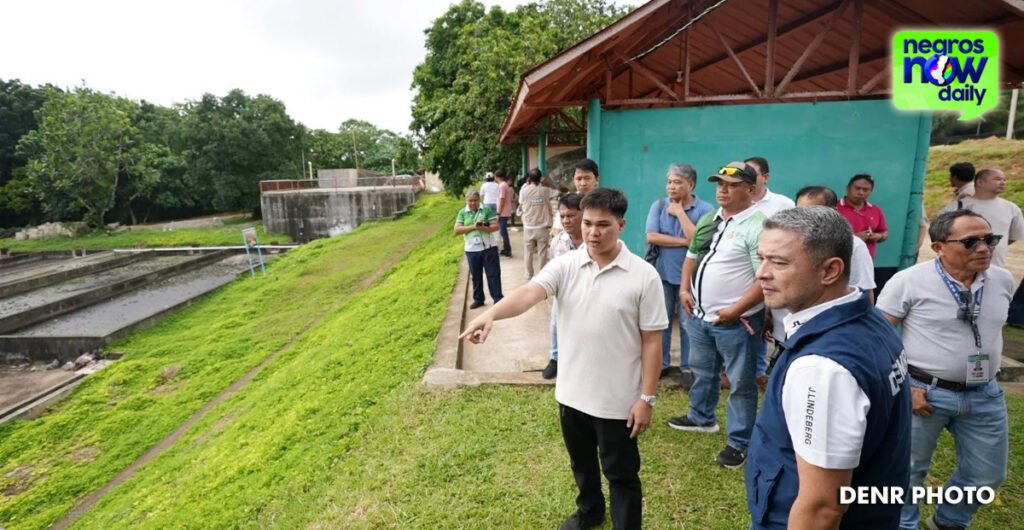
Central to the city’s operations is the 27.4-hectare BCWMEC established in 2010. The facility features a sanitary landfill cell, a Materials Recovery Facility (MRF), a composting unit, a special waste vault, and a septage management system, the DENR said Aug. 31.
The BCWMEC currently serves all 28 barangays of Bayawan, with 117,900 residents, along with five neighboring LGUs and three private firms.
Bayawan’s present status stands in contrast to the late 1990s, when unsegregated household waste and open dumping in Sitio Buli-Buli, Barangay Banga posed severe health and environmental risks. In response, the city formulated its Solid Waste Management Plan in 2002 and instituted mandatory source segregation, systematic collection, recycling, and composting enforced via local ordinances.
Under a Pay-As-You-Throw scheme, sacks of residual waste require designated stickers prior to collection, while unsegregated waste is refused and violators face penalties, the DENR said, adding that aggressive information, education, and communication (IEC) campaigns across barangays support these regulatory policies to maintain high compliance rates.
Through these measures, about 80 percent of waste segregation is completed before final disposal, recovering valuable recyclables and significantly reducing overall waste volume. Deputized enforcers maintain active monitoring for illegal dumping and nighttime violations.
The city’s progress has also involved navigating operational hurdles. In 2023, Bayawan faced a Notice of Violation from the DENR due to failing effluent wastewater standards. Technical assistance from the DENR enabled the city to address the issue and restore full compliance.
“There was a time na hindi pumasa yung effluent wastewater namin, and DENR issued us a Notice of Violation,” recalled BCWMEC assistant manager Irvin Joshua Elum. “But they did not stop there. Tinulungan nila kami kung pano ma-resolve yung situation, nagbigay sila ng technical advice and thankfully, na-address yung problem, and nakapasa na tayo.”
The city government’s waste management initiatives have earned national recognitions, including awards from DENR-NIR and the Presidential Lingkod Bayan Award conferred by the Civil Service Commission to the Bayawan Integrated Waste Management Team.
“Bayawan shows us that environmental laws work when they are implemented consistently and when communities are made part of the solution. This is a model that other LGUs can learn from and adapt to their own local conditions,” Cuna stressed.
The DENR continues to urge local governments nationwide to enforce waste segregation at source, maximize diversion, and adhere strictly to RA 9003 to protect public health and the environment. ||