
• THERESA MAE DULMAN
Members of the National Federation of Sugar Workers (NFSW) staged a picket protest as they submitted a position paper to the Department of Labor and Employment (DOLE) and the Bureau of Workers with Special Concerns (BWSC) office in Bacolod City Aug. 27.
The group pointed to the widespread practice of pakyaw (piece-rate) as the primary driver behind depressed wages and the disparity in Social Amelioration Program (SAP) benefits under Republic Act 6982.
The NFSW demanded an end to wage-depressing practices, and called for a mandatory minimum amelioration bonus of not less than P5,000 for field and migratory sugar workers, to help them survive the off-milling season from May to September.
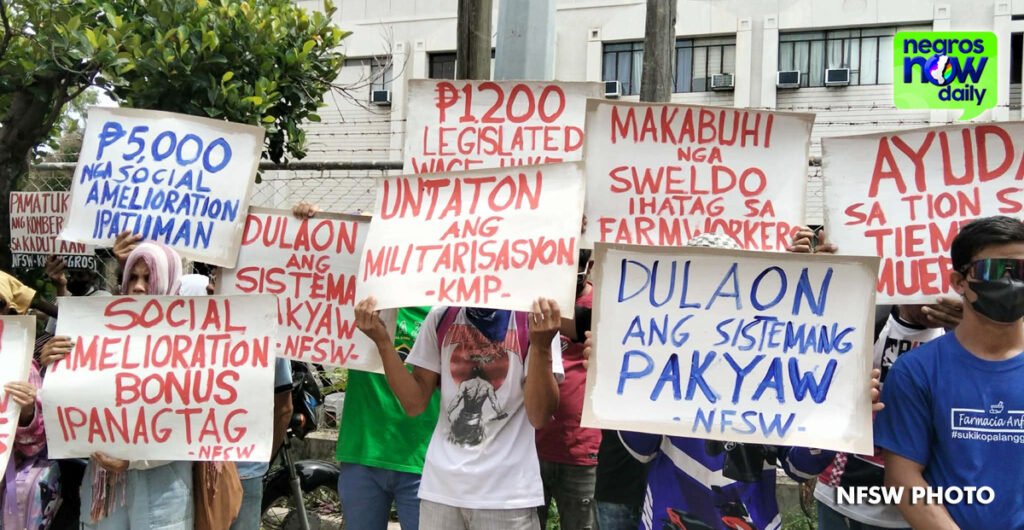
They also urged the DOLE to simplify the process for registered worker unions to access socio-economic project funds, which, according to them, are currently dominated by landlord-led institutions, and to increase allocations for maternity and funeral benefits for workers.
The group said majority of the field workers received dismal amount during the distribution of the Social Amelioration Bonus (SAB).
“On average, field workers receive P200 to P400 every year, too low to carry them to fight through the lean months of closed season,” the group said.
They added that migratory field workers, including the karga-tapas employed by contractors, work without social benefits.
“Field workers are not listed by the sugar planters as majority of the sugar farms do not use payroll or give pay slips to its field workers, denying them their rightful share in the production sharing scheme. In sugar mills, those who are employed in pakyaw work are not receiving SAB as mandated by the law,” the group stressed.
They noted that mill employees and workers in the bioethanol plant receive a SAB of not less than P10,000, while the farm management officers and office workers receive amount far higher than the field workers. | TMD