
• GILBERT P. BAYORAN
Negros Electric and Power Corp. (Negros Power) expects the frequency and duration of manual load dropping (MLD) or rotational brownouts in its central Negros franchise area to gradually decrease this month as more power plants resume operations.
In a press conference on Monday, Sept. 7, Engr. Joe-Mel Zaporteza, vice president and chief operating officer of Negros Power, said the power situation is expected to improve in September, with some generation companies expected to return online beginning this month and others possibly resuming operations toward the latter part of the year.
Zaporteza said the improvement was already evident on Monday when the MLD lasted for only about one hour despite a red alert issued by the National Grid Corporation of the Philippines (NGCP).
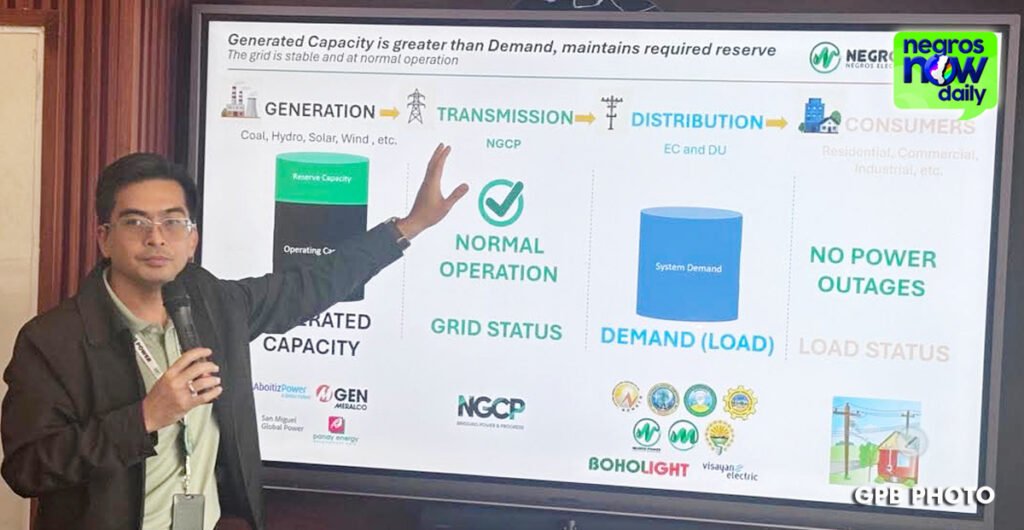
“This is significantly shorter than the four- to five-hour MLD periods experienced in previous days,” he said.
However, Zaporteza cautioned that instances of MLD may still occur until the end of the year, depending on the availability of generation capacity.
He explained that the rotational brownouts were primarily caused by insufficient power generation, particularly as several power plants in Cebu and Panay experienced forced outages and scheduled maintenance.
MLD began affecting Negros Power’s customers in May, initially lasting around 30 minutes to one hour.
However, the situation worsened in August when several power plants remained offline, widening the gap between available supply and demand and forcing the distribution utility to implement longer load dropping periods of up to two to three hours.
Zaporteza also explained that the availability of solar power helps reduce the supply deficit during daytime, with the gap sometimes reaching zero between around 1 p.m. and 2 p.m. when solar generation is at its peak.
The situation changes toward the evening, however, when solar generation declines while electricity demand increases.
“The deficiency becomes bigger toward the evening,” he said, explaining that the reduction in solar output contributes to the widening supply gap at night.
Zaporteza added that Negros Power continues to explore available sources of electricity, including smaller power generators and distributed energy resources, to help bridge the supply gap and manage demand.
As a distribution utility, Zaporteza said Negros Power’s primary role is to distribute the electricity made available by generation companies.
He likened the situation to a grocery store that cannot distribute products if factories are unable to produce enough supply.
“We understand the sentiments of consumers because we are also being blamed for the power outages,” Zaporteza said, adding that MLD is also inconvenient for the company and that it is working to minimize its impact on customers.
Zaporteza said transmission capacity is another factor that limits the amount of electricity that can be delivered to the Visayas.
The transmission connection from Leyte has a capacity of about 400 megawatts while the interconnection from Mindanao provides around 100 MW.
Even if Luzon has excess generation, the amount that can be transmitted to the Visayas remains constrained by the capacity of the transmission lines.
Zaporteza said Negros Power adjusts its distribution system based on the imbalance in the grid and implements MLD when necessary to maintain system stability.
For pre-arranged power interruptions related to maintenance and rehabilitation, Zaporteza said the company plans and sectionalizes its distribution lines to minimize the number of affected customers and shorten the duration of outages. | GPB