
• NESSA RAE APOSTOL
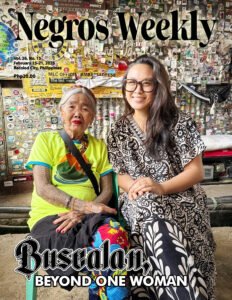
The writer, a photojournalist, is currently based in Paris, France, where she is pursuing her master’s degree. She works internationally as a feature writer and documentarian. Her storytelling centers on culture, history, and anthropology, with a deep commitment to reclaiming and celebrating Filipino identity.
Her work has been published in Forbes, Vogue and Elle Magazine. She also had a background in fashion and professional dance.
Between work projects, she prefers to spend her time in Bacolod with family, grounding her global perspective in her Visayan roots.
She was in Buscalan on Dec. 26-30.
More of her work can be found on Instagram at @ariesmedia.style.
***

I arrive in Buscalan exhausted before I ever reach it.
I am used to solo travel and going off the beaten path, so honestly, I can say this is one of the roughest journeys I have experienced. My day begins at 3 a.m. in Bacolod, followed by a flight to Manila, a few hours of rest in a 24-hour check-in hotel, and then a 12-hour overnight drive through winding mountain roads.
Motion sickness, lack of sleep, and an aggressive driver compound the strain. By the time we reach Tinglayan around 3:30 a.m., I have not slept more than a few hours in nearly two days. I am delirious to the point that it is painful.
We are not allowed to enter the village yet. We wait at the base of the mountain until dawn, sitting in the dark while an elderly local man—likely a relative of Apo Whang-Od—mans the area and offers coffee to visitors. We sip as the sky begins to change color.
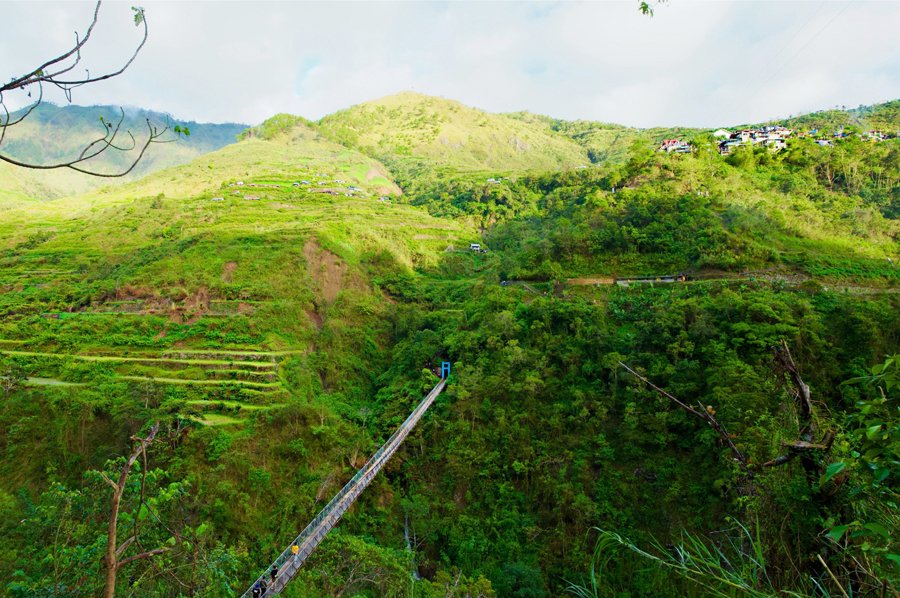
As the sun rises, Buscalan slowly reveals itself: a vertical village carved into the cliffs at the top of the mountain, rice terraces folded into the slopes below, waterfalls cutting through the landscape, and a river separating this mountain from the next. Carabaos lie directly on the road, unbothered by cars or people, sleeping where they please. The sky shifts from deep blue to pink, orange, and gold.
It becomes clear this place is not simply a destination. It feels like a place that must be earned.
Our bags and supplies are sent up by zip line. We hike down one mountain, cross a long, narrow suspension bridge that visibly swings with each step, and then climb back up steep dirt paths and concrete stairs. The bridge is just wide enough for one person. The planks shift beneath your feet. The drop below is far enough that fear becomes audible—screams from people ahead echo across the valley.
By the time we enter the village, life is already in motion. Villagers stand outside their homes, observing from above as we—the newcomers—look up at them. Visitors and locals exchange warm but timid greetings of “Good morning, po.” There is no performance here. Just two worlds observing one another with mutual curiosity.
Most of the visitors are Filipinos from cities in Luzon, largely Manila. I am the only Visayan in our group. I see only two non-Filipinos: my friend Chinni, a travel vlogger from Thailand, and another visitor I believe is from Germany.
We settle into a homestay near the top of the village, beside the church. The homes are simple and meticulously clean—foam mattresses laid wall to wall across the floor, thin blankets, pillows, and an outdoor tabo shower, where water is poured by hand using a small bucket and dipper.
There are no hotels. No Airbnbs. Homestays are managed entirely by the villagers, and entry into Buscalan is only permitted with approved local guides.
Tourism here is not accidental. It is controlled, deliberate, and intelligently structured.
Walking through the village requires constant awareness. Paths are steep and narrow. Some have no guardrails. At times, you walk directly through someone’s front doorway, passing conversations mid-sentence, children being bathed, and meals being prepared.
Life is not paused or separated for visitors. You move through it, adjusting yourself to the rhythm already in place.
Food appears consistently. Not the kind of Filipino food that circulates on social media—no party dishes, no novelty. We eat dried salty fish, sweet pork, sour tamarind soup, bitter melon, and vegetables steeped in shrimp paste. There is coffee everywhere—local beans with a little sugar, nothing else.
What stays with me is not only the food itself, but how it is shared. The women who cook, clean, tattoo, and host us eat the same food we do. They sit with us. They snack alongside us. This is not service. It is hospitality in its truest form.
Certain value systems here immediately stand apart from the rest of the Philippines. Marijuana grows openly and abundantly in the village and surrounding mountains. It is a normalized part of life.
Mushrooms are socially accepted. Cigarettes, however, are strictly not allowed. This inversion of moral norms—especially within a country shaped by Catholic doctrine and colonial rule—signals that Buscalan operates by a different set of cultural laws.
The But-But people are a subgroup of the Kalinga, a mountain culture historically shaped by fierce resistance and defense of land. For generations, the Kalinga practiced headhunting within a structured system of honor, protection, and balance. Men earned tattoos through acts of bravery—marks that recorded raids, leadership, and survival.
Jaws were kept as proof of valor and defense of the community. These practices were not indiscriminate violence. They were part of a deeply ordered system of meaning.
The terrain of the Cordillera mountains, combined with this warrior culture, made Spanish colonization nearly impossible here.
Because of tourism, the villagers speak multiple languages. Tagalog—the national language and the dominant language of Luzon—is widely spoken. English is also common. In fact, I found many villagers more comfortable speaking English than people in Manila. Still, their primary and dominant language remains But-But, which continues to anchor daily life and identity.
Knowing this history reframes everything. The warmth of the village today does not contradict its past. It is shaped by it. The women laughing beside me descend from a lineage forged through protection and resilience.
Tattoos that now appear artistic and beautiful once marked lives lived at the edge of survival. What has changed is not strength. It is how it is carried.
Everyone in Buscalan is tattooed. Arms, legs, bodies, and faces—marks appear everywhere, worn without self-consciousness.
For women, tattoos are not rebellion or deviation. They are beauty, maturity, and belonging. Some women wear small marks on their faces—tiny X-like symbols placed near the eyes, tips of the nose, and cheeks, believed to signify lineage and, historically, the daughters of headhunters. Meanings shift over time, but the presence of these marks remains unquestioned.
To witness so many Filipino women covered in traditional tattoos is striking. Outside the mountains, tattoos in the Philippines are often discouraged or stigmatized—a legacy of colonial rule and imposed religious and aesthetic standards.
Here, female bodies are not sites of shame. In a culture where women were once topless, tattoos were meant to enhance their beauty.
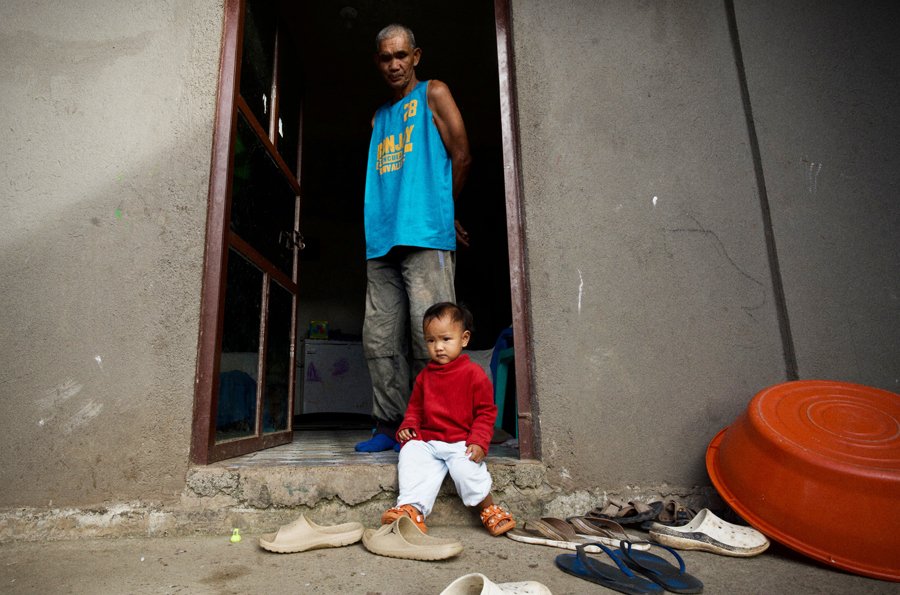
Learning batok (tattoo art) is not reserved for a few. Everyone in the village is taught, beginning around the age of 10. Knowledge is passed hand to hand, generation to generation, ensuring that the practice belongs to the community rather than to any single individual.
I had prearranged a private meeting with Apo Whang-Od, the 109-year-old mambabatok (she celebrated her birth anniversary of Feb. 17) who was featured in the cover of Vogue Philippines in 2023, but I was advised to remain flexible. I go to her home independently to observe her at work. She is surrounded by people waiting to be tattooed. I observe her for nearly 30 minutes before lifting my camera.
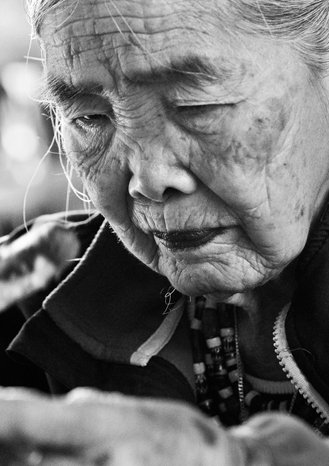
She works with precision. Her eyes are sharp and alert, her eyebrows moving subtly with each sequence of taps. When her gaze shifts sideways, it is piercing and direct. Her expression is often serious, but when she smiles, it fills her entire face—eyes narrowing, gums visible, laughter quick to follow.
There is a youthful energy to her, paired with unmistakable authority. She is clearly in charge and deeply respected.
Apo Whang-Od learned batok from her father, who was also a mambabatok. There are stories about her that circulate—how she fell in love once as a teenager, and when the boy died, she never loved again. It is said that a mambabatok who marries or has children cannot fully dedicate herself to the practice.
Whether belief or lived truth, Apo chose devotion. She never married. She never had children. Her life has been given entirely to batok.
Tattooing in Buscalan is constant. It unfolds alongside cooking, cleaning, and conversation. Apo Whang-Od works seven days a week, from 7 in the morning until 5 in the afternoon. Because of her eyesight and energy, she now tattoos only her three-dot signature. The more complex designs are carried out by her descendants, ensuring the continuation of the practice beyond any single person.
That evening, the village experiences a brownout—a power outage common in the mountains. Work continues regardless. Tattooing moves outdoors, lit by campfire, headlights, and cellphone lights.
The tools are simple: bamboo sticks, pomelo thorns, ink made from soot and water, coconut oil or petroleum jelly worked gently into the skin. The same women who tattoo us prepare our meals.
In 2007, anthropologist and blogger Lars Krutak lived with the But-But tribe for a month, fully immersing himself in village life. At the time, Apo Whang-Od was the only practicing mambabatok, and Buscalan was largely unknown beyond the surrounding region. Krutak documented her work, her teachings, and the training of her then 11-year-old grandniece, Grace.
After his research was published, Apo’s work reached a global audience. It was through this exposure that the wider world first learned of Buscalan.
Today, Grace is a master tattoo artist in her own right—and one of the women who tattoos me.
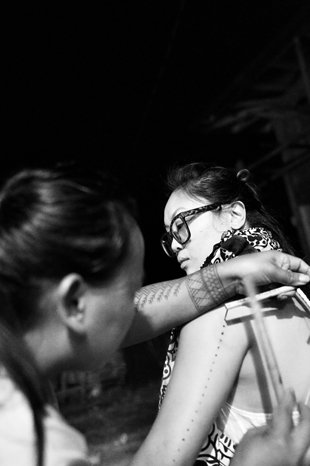
My tattoo consists of 39 batok dots, beginning at the top of my arm and running downward toward my wrist, intentionally leaving space for Apo to complete it when I return. The design was stenciled using a thin piece of young bamboo and the same soot-and-water mixture used for the ink. The dots were permanently placed by eight women—Apo’s descendants—each contributing to the same line. This was done deliberately.
The tattoo is not a mark of one hand or one artist, but of lineage. Being struck one by one by each woman, under a star-filled sky and beside a blazing campfire, is an experience I will never forget. The descending line represents continuity: the women of Buscalan, the lineage of mambabatok, and my own family line, carried through the body rather than recorded on paper. It is incomplete by design. The space left is a promise.
Conversations with the younger women unfold alongside work. They speak while cooking, cleaning, and tattooing. Hands stay busy as stories emerge. At one point, they invite me to sit on the floor by the window and eat jicama dipped in vinegar and chilies. We sit shoulder to shoulder, talking as the village moves around us.
At first, some of them are nervous. English is not a language they often practice in depth, and visitors rarely engage with them this way. But when they realize I am not shocked by their lives or romanticizing them, they warm quickly. They tell me they are surprised—city Filipinos rarely sit with them out of curiosity or for learning. Laughter follows. Jokes come easily. By the time I leave, affection feels natural.
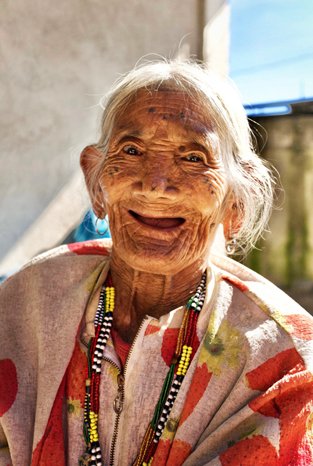
Apo Whang-Od is not the oldest person in Buscalan. I meet Apo Pas-ad, who is 118 years old. She is tiny—no more than 4 feet tall—walking along the cliffs, hunched with age but full of life. She does not say much, but she is deeply aware and visibly delighted by the world around her.
Nearby, I meet another woman who is 110. Apo herself is 109 now. Time here does not feel linear. It feels layered.
Meeting women who have lived well past a hundred naturally raises questions, and I begin paying closer attention to daily rhythms. Food in Buscalan is built around subsistence, seasonality, and labor. Rice anchors every meal, grown in terraces carved directly into the mountains and harvested by hand. Vegetables come from small household gardens and surrounding land—bitter melon, chayote, squash, sweet potato, eggplant, tomatoes, leafy greens, bamboo shoots, banana blossom, munggo beans, and other local legumes—prepared plainly, most often boiled or stewed. .m
Protein is modest and practical. Eggs are gathered daily. Chickens roam freely through the village and are eaten occasionally. Fish appears both dried and fresh. Pork is reserved for life events and communal gatherings—indigenous holidays, centenarian birthdays, weddings, and funerals—when neighboring villages come together and cook the whole pig. Coffee is constant. Spicy food is uncommon. Chocolate, not grown here, is accepted gladly as a gift and shared. There is little oil and little excess.
Movement follows the same logic. Life here is shaped entirely by terrain rather than intention. The village is vertical, stitched together by narrow paths, steep stairs, bridges, and cliff edges.
In many places, the drop beside these walkways falls hundreds of feet into the valley below.
Young children run across swinging bridges and uneven stone paths without hesitation. Elderly women wobble along the same routes, slowed by age but unphased by the height. Adults—including grandmothers—balance heavy loads on their backs or heads with practiced ease. These paths are not ceremonial. They are necessary. Balance is learned early and carried for life.
Before leaving, I meet Apo Whang-Od officially for the first and last time. We had attempted to arrange an interview three separate times since my arrival, but she is simply too busy. People line up for her work from morning until late afternoon, and there is no interruption to her rhythm.
As my time in the village unfolds, it becomes clear that Apo is only one part of a much larger system. So many women here carry the work, the knowledge, and the continuity of batok, yet their contributions rarely receive public recognition.
I am grateful to have seen them, listened to them, and learned from them.
Apo looks up briefly, smiles, and nods—an acknowledgment, a simple thank you for coming.
There is no closing ritual. No ceremony for departure. Life continues exactly as it was before we arrived.
I leave without disappointment. Instead, I leave with clarity. This time was not meant to center one person. It was the village’s time to be seen.
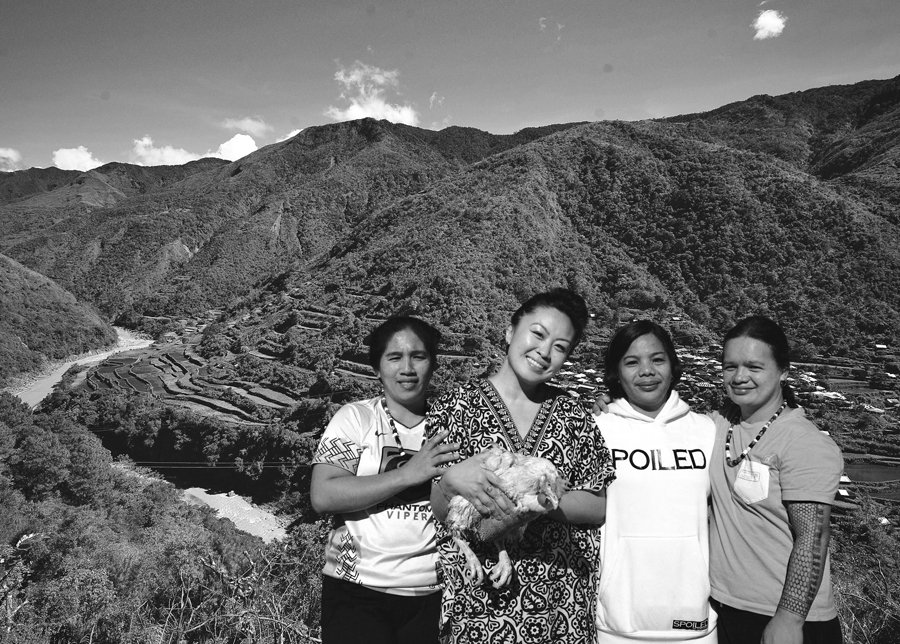
What stays with me is the understanding that Buscalan is not a story about one woman. It is a story about an entire village that has structured its life around art—not as spectacle or exception, but as foundation. Knowledge is shared. Labor is collective. Women are essential.
In a country where art is rarely supported as a viable livelihood, Buscalan stands apart.
Here, art is inseparable from survival, community, and lineage. This way of living is rare. It is something I value deeply—not only as a photographer, but as a person shaping my own life around purpose, continuity, and devotion to practice. | NWI
***
Editor’s Note: The article text accompanies an ongoing photographic project developed in Buscalan, Kalinga, Philippines. All observations are based on firsthand immersion, informal interviews, and direct participation in daily village life.
The project is based on firsthand observation, informal interviews, and lived immersion in Buscalan village, supplemented by historical and anthropological sources for contextual accuracy.