
The Philippine Statistics Authority (PSA) reported that nearly half of the population aged 15 and above in the Negros Island Region (NIR) have experienced migration.
Ma. Goretti Novilla, chief statistical specialist and regional chief of the Statistical Operations and Coordination Division (SOCD) of PSA-NIR, explained Nov. 25 that migration refers to the movement of people from one geographical area to another involving a change in their usual residence within a specified period.
“Migration is a form of geographic or spatial mobility of people involving a change of usual residence between clearly defined geographic or political units during a specified period of observation,” Novilla said.
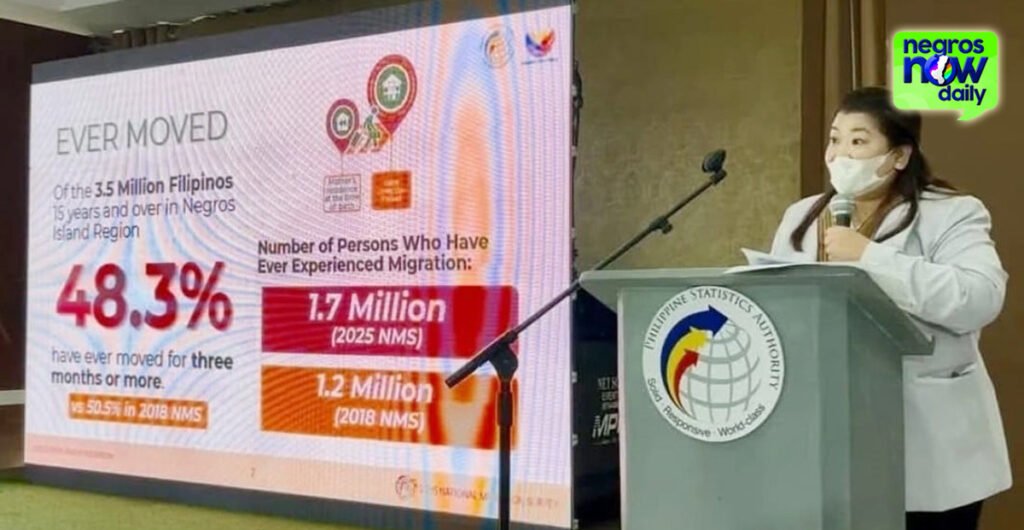
She explained that the term “ever moved” refers to individuals who have transferred or resided in another city or municipality, province, region or country for at least three months.
Migration experiences are classified into four categories: internal migration, or movement within the Philippines; international migration, or movement abroad; both internal and international migration; and those who have never experienced migration.
Of the 3.5 million residents aged 15 and above in the NIR, 48.3 percent, or approximately 1.7 million individuals, have experienced migration lasting three months or more.
For their first internal migration, the three leading migration flows were from the NIR to the National Capital Region (NCR), involving 508,000 individuals; Central Visayas, with 179,000; and Calabarzon, with 171,000. The three destinations account for about 858,000 of the 1.7 million ever-moved residents; the remaining migrants either moved to other areas or made an international move as their first migration, PSA-NIR said.
Meanwhile, lifetime migration among the 3.5 million residents aged 15 and above who were born in the Philippines and currently reside in the NIR stood at 34 percent, equivalent to approximately 1.2 million lifetime migrants.
Of the recorded lifetime migration figures, 8.3 percent involved inter-regional movement, 25.7 percent intra-regional migration, 1.2 percent inter-provincial movement, and 24.6 percent inter-city or municipal migration. PSA-NIR said the categories overlap, as a migrant may fall under more than one type of movement, which is why the shares do not total 100 percent.
EMPLOYMENT, FAMILY
Peter Enfestan, senior statistical specialist of PSA-NIR, said in a Philippine News Agency report that employment, family considerations and education were among the major factors influencing international migration.
For individuals’ first international move since birth, the top three reasons were employment or job changes, retirement, and moving to live with their parents.
For those whose most recent international migration occurred within the past five years, the leading reasons were employment or job changes, marriage, and schooling. The two sets of reasons refer to different questions: the first-ever move abroad, and the most recent move within the past five years, Enfestan said.
Data also showed the leading occupations among employed international migrants aged 15 and above during the five years preceding their migration to their last country of destination.
EMPLOYMENT DIFFICULTIES
Despite the opportunities associated with working or residing abroad, returning international migrants also encountered challenges upon their return to the PH.
Among international migrants aged 15 and above who returned to the country, 64.6 percent reported experiencing difficulties upon their return.
The findings highlight the different migration experiences of residents of the NIR, including their reasons for moving, employment opportunities abroad, and the challenges they face when returning to the PH. ||