
• GILBERT P. BAYORAN
The sugarcane deep planting technology transfer from Japan to the Philippines led to an increased yield to 77.23 tons per hectare, from only 63.92 tons per hectare for manual planting, according to a study of the Sugar Regulatory Administration (SRA).
SRA Administrator Pablo Luis Azcona said the increase in sugarcane yield is equivalent to 28.2 bags of sugar or an increase in income of P68,125 per hectare.
Japanese Ambassador to the Philippines Endo Kazuya, who spoke at a symposium on Sustainable Development of Sugarcane Cultivation held at Sugarland Hotel in Bacolod City on Dec. 1, lauded the efforts of his country and the Philippines in addressing challenges in the agriculture sector.
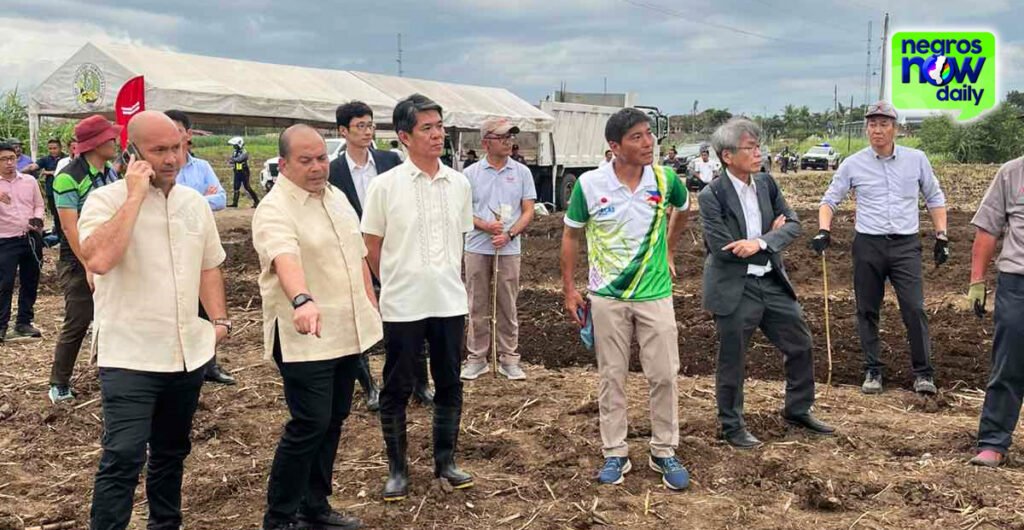
During the ASEAN Plus Three meeting on October, former Ministry of Agriculture, Forestry, and Fisheries Minister Koizumi Shinjiro visited the Philippines, and even held a bilateral discussion with Secretary Francisco Tiu Laurel to strengthen the Philippines’ sugar industry.
Kazuya said the deep-planting cultivation technology developed by Japan International Research Center for Agricultural Sciences (JIRCAS) in collaboration with SRA not only boosts agricultural productivity, but also pioneers innovative, sustainable technologies.
“It ensures sustainable sugarcane production, even in extreme weather conditions,” the Japanese diplomat said.
Kazuya further said that the ongoing collaborations centered on soil runoff control, carbon sequestration, and soil fertility improvement further enhances sustainability in agricultural practices, stressing also that these initiatives are a critical part of a broader effort to foster sustainable agricultural development.
The Japanese ambassador also reported that SRA and the University of Tokyo signed an agreement in March 2025 to further advance practical sugarcane research. This partnership will seek to develop new technologies and improve systems, explore how sugarcane can benefit various industries such as the development of bioethanol, Kazuya said.
The JIRCAS headquarters, which is located in Okinawa, Japan, is known for its unique brown sugar called kokutō. Its mills lead the way in producing clean energy using cane fiber (bagasse).
With the two countries sharing many similarities — high temperatures and humidity, rice-based farming systems, and a strong presence of small and medium-sized farmers, Kazuya said these strategic similarities create rich opportunities for mutual learning, innovation, and strengthened cooperation.
“As we share insights and chart our next steps, let us keep in mind our ultimate goal: to meaningfully improve the lives of our sugarcane farmers, whose dedication and tireless efforts form the backbone of this industry,” he added.
Kazuya said: “I sincerely hope that the success of this project will create a lasting, positive impact — through strengthening food security, advancing agricultural resilience, and, above all, uplifting our farmers and our communities.” | GB